
 Image 1 of 1
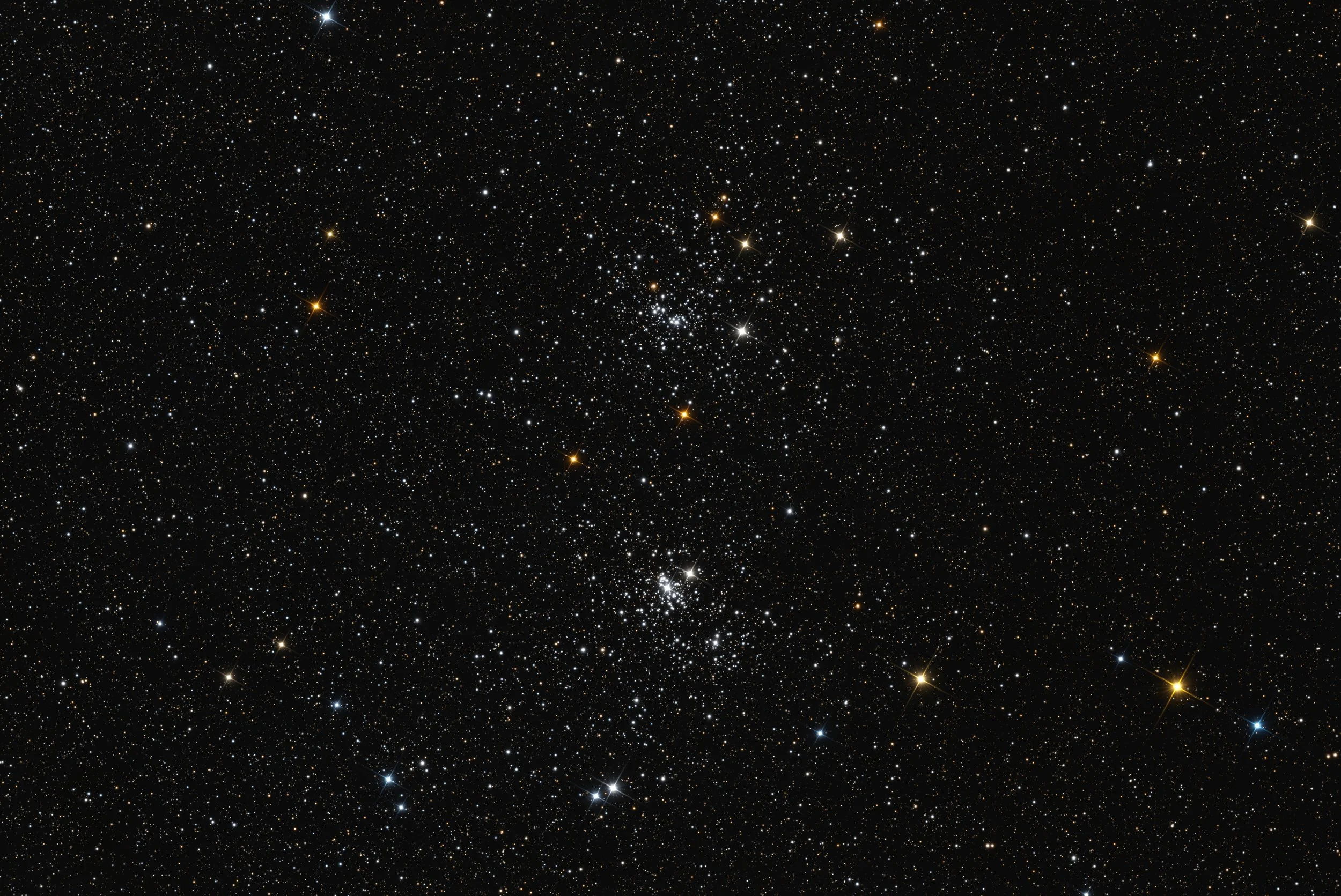
These two bright open clusters, also called NGC 869 and NGC 884, appear side by side, about halfway between the bright stars in the constellations Perseus and Cassiopeia. Located about 7,500 light-years away, the clusters contain hundreds of hot, young stars that cause them to shine with apparent magnitudes of 5.3 and 6.1 in our sky. To the naked eye, the two clusters look like one large hazy patch, but binoculars and telescopes neatly split the pair, providing beautiful views of this celestial treasure. The Double Cluster appears highest for Northern Hemisphere observers during the late fall or early winter. (Southern Hemisphere observers close to the equator should look for it in late spring or early summer.)
These two bright open clusters, also called NGC 869 and NGC 884, appear side by side, about halfway between the bright stars in the constellations Perseus and Cassiopeia. Located about 7,500 light-years away, the clusters contain hundreds of hot, young stars that cause them to shine with apparent magnitudes of 5.3 and 6.1 in our sky. To the naked eye, the two clusters look like one large hazy patch, but binoculars and telescopes neatly split the pair, providing beautiful views of this celestial treasure. The Double Cluster appears highest for Northern Hemisphere observers during the late fall or early winter. (Southern Hemisphere observers close to the equator should look for it in late spring or early summer.)