
 Image 1 of 1
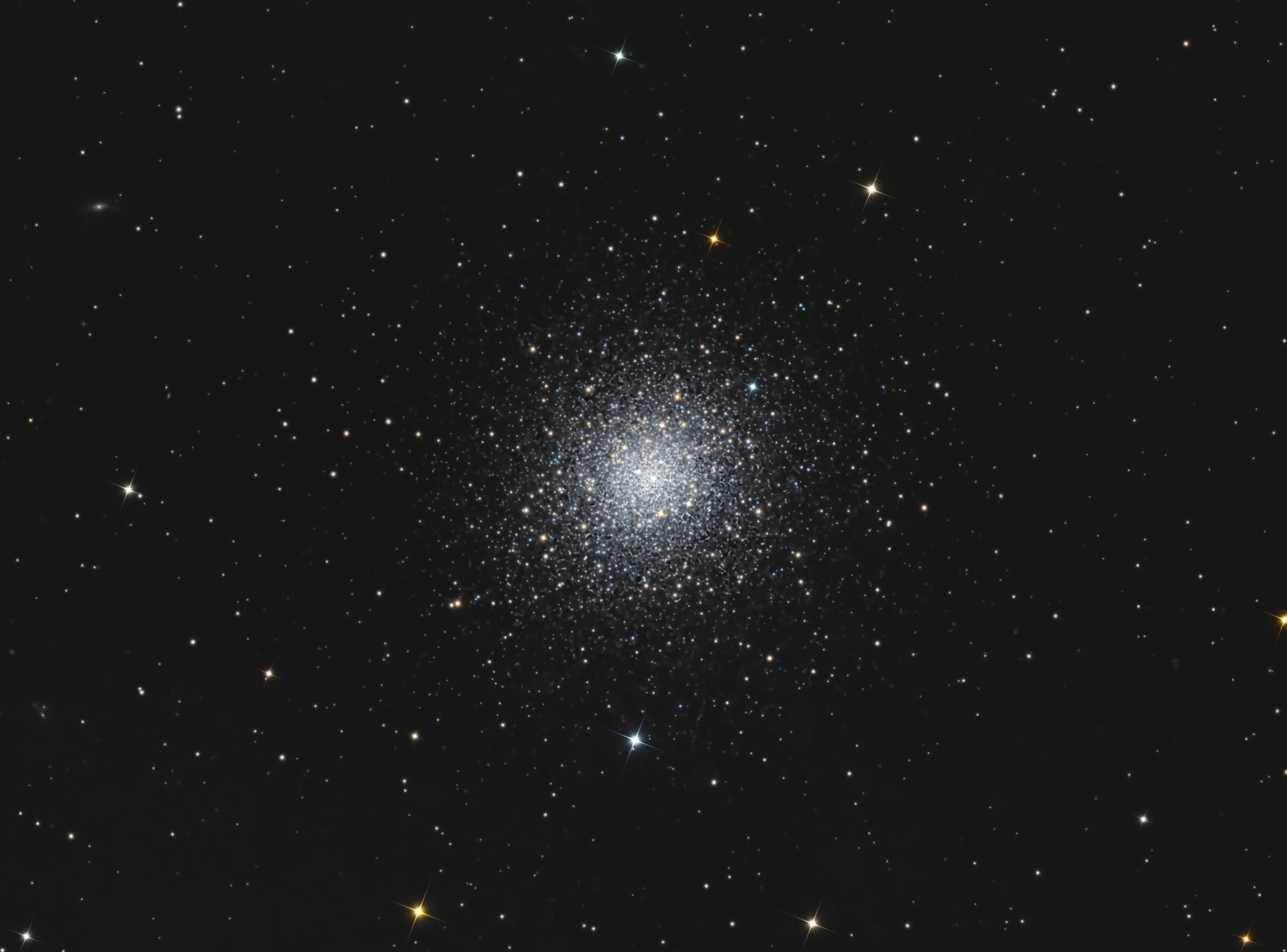
Located 27,000 light-years from Earth in the constellation Hercules, this globular cluster — a ball of stars that orbits our galaxy’s core like a satellite — was first discovered by the German astronomer Johann Elert Bode in 1777.
With an apparent magnitude of 6.3, M92 is one of the brightest globular clusters in the Milky Way and is visible to the unaided eye under good observing conditions from a dark-sky site. Stargazers can most easily spot M92 during the month of July. The cluster is very tightly packed with stars, containing roughly 330,000 of them.
As is characteristic of ancient globular clusters — of which M92 is one of the oldest — the predominant elements within M92 are hydrogen and helium, with only traces of others, so it belongs to a group of metal-poor clusters. To astronomers, metals are all elements heavier than hydrogen and helium.
Located 27,000 light-years from Earth in the constellation Hercules, this globular cluster — a ball of stars that orbits our galaxy’s core like a satellite — was first discovered by the German astronomer Johann Elert Bode in 1777.
With an apparent magnitude of 6.3, M92 is one of the brightest globular clusters in the Milky Way and is visible to the unaided eye under good observing conditions from a dark-sky site. Stargazers can most easily spot M92 during the month of July. The cluster is very tightly packed with stars, containing roughly 330,000 of them.
As is characteristic of ancient globular clusters — of which M92 is one of the oldest — the predominant elements within M92 are hydrogen and helium, with only traces of others, so it belongs to a group of metal-poor clusters. To astronomers, metals are all elements heavier than hydrogen and helium.